
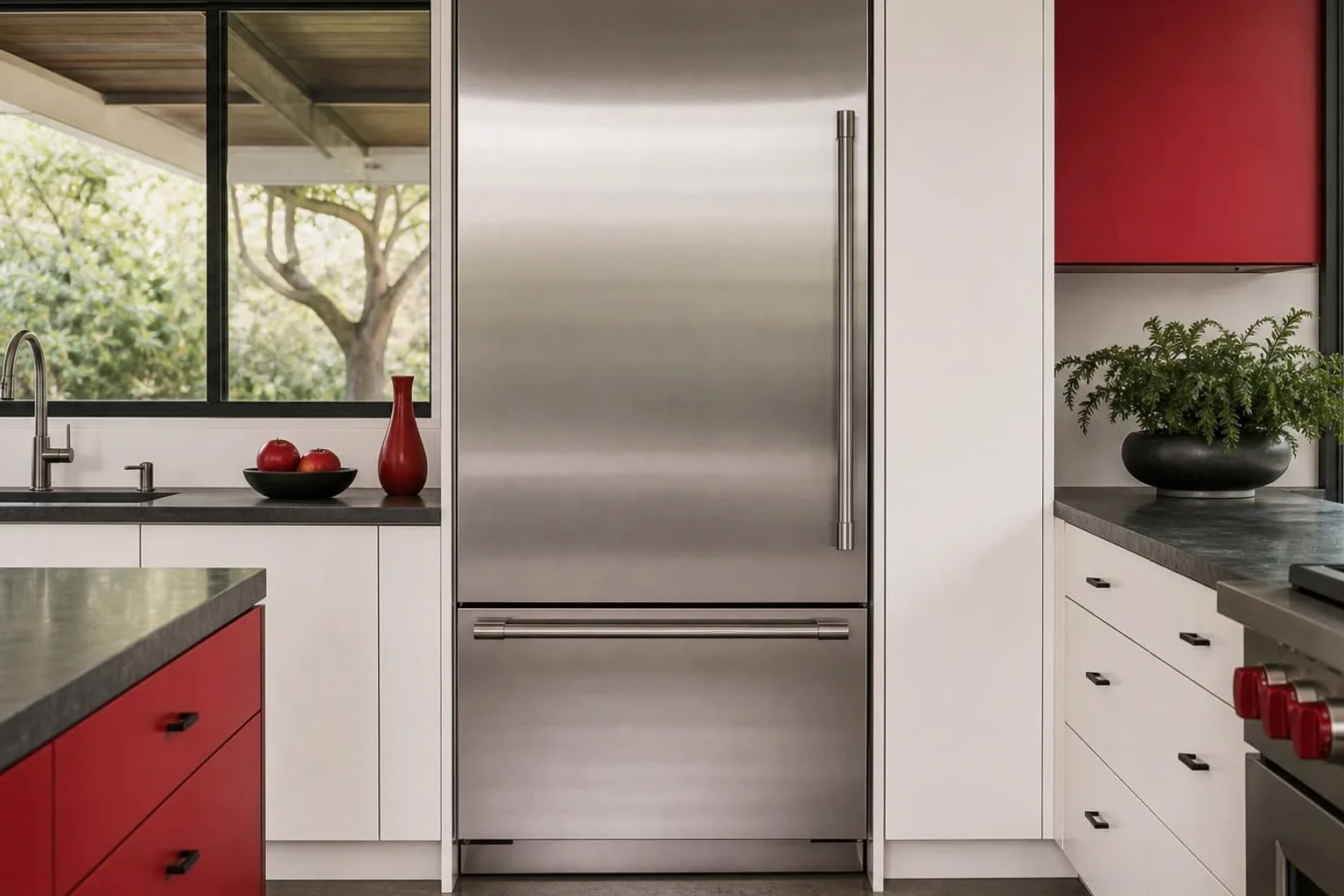
Sub-Zero 632 Case Story · 4 min read
Two Visits to Catch a Sub-Zero 632 That Kept Healing Itself
A Crescent Park Sub-Zero 632 warmed up every few days and recovered before anyone could catch it. Two visits, one failing relay, and an $865 exchange board.
4.9/5 · 689 reviews · $89 call waived with repair

For most of the spring, a 2003 Sub-Zero 632 in Crescent Park played a private joke on its owners: every few days the fresh-food side drifted warm, then recovered before anyone could catch it. The fault was a failing compressor relay on the original main control board, and the fix was a rebuilt exchange board. The final bill was $865, parts and labor, with our $89 service call waived because the repair went ahead. It took two visits, because the fault refused to perform while I stood in the kitchen.
After 22 years on appliance controls I can say intermittents are their own discipline: a dead part confesses immediately, a failing relay has to be hunted. Here is the log of that hunt.
A 632 That Would Not Stay Broken
A Crescent Park household described a Sub-Zero 632 that had twice let the milk go borderline and the ice cream soften, then pulled itself together before a visit could be booked. The unit was original to a 2003 remodel and had never needed more than a condenser cleaning. The one constant was a light clicking from behind the grille, on no schedule they could find. Random warm-ups with full recoveries are a pattern, and on a 632 of this vintage the pattern points at the electrical side long before refrigerant.
Visit One: Nothing to Catch
The first visit went the way intermittent calls go. The cabinet held its setpoint, the compressor ran politely, and the event review turned up no stored fault code at all. What I did get was the sound: under load, faint relay chatter at the main board, contacts making and breaking when they should have sat closed. That is a clue, not a conviction. An intermittent relay fault on a Sub-Zero 632 rarely stores a code, because the control doing the logging is the component doing the failing. I asked the owners to log every episode and left with only a suspicion.
Visit Two: The Dropout
Late in May the owners called mid-episode, and this time the 632 performed. With the cabinet drifting warm, I metered the board's compressor relay and watched the load-side supply fall out and return while everything upstream stayed steady. Worn contacts inside the relay closed cleanly on some cycles and floated on others; each float cut the compressor's feed and let the cabinet warm, and each catch quietly healed it. A relay that drops compressor power intermittently will warm a Sub-Zero 632 for half a day, then hand it back as if nothing happened.
Five Days for the Right Board
You do not rework a tired relay soldered into a twenty-year-old board, not to a standard I will sign. The fix is a rebuilt exchange main control board: a remanufactured board goes in, and the old one ships back as the core. Exchange boards are not shelf parts; ours arrived in 5 days, inside the 4 to 7 days these swaps usually take. With the exchange board installed, the unit ran a monitored 48 hours without a single dropout at the compressor relay, the clean comparison run that convicts the old board.
What $865 Actually Bought
The invoice came to $865, parts and labor, and the $89 service call was waived, as it always is when the customer proceeds with the repair. A main control board exchange on a Sub-Zero 632 usually lands between $650 and $1,250 installed, so this bill sat mid-spread and inside the $350 to $1,250 control board and sensor range we publish for Palo Alto work. The exchange program keeps the number down: a rebuild priced against your returned core, not collector pricing on a discontinued part. The rest bought patience, two visits and a monitored run, the real cost of proving an intermittent.
If Your 632 Heals Itself
Do not let the recovery talk you out of the call. A Sub-Zero that warms up and then fixes itself is not fine; it is failing on a schedule you have not decoded yet. Note when each warm-up happens and listen for clicking behind the grille; that chatter is the fault introducing itself. Then insist on evidence. No stored error code does not mean no fault; on a 632 it often means the control itself is the suspect. The diagnosis that counts is a meter on the relay under load; the proof is a clean monitored run afterward.
Answers
Questions & answers
How much does a Sub-Zero 632 control board replacement cost?
Usually $650 to $1,250 installed with a rebuilt exchange board. This Crescent Park job billed $865 total, parts and labor, with the $89 service call waived.
Can a Sub-Zero 632 control board be replaced the same day?
Rarely. Exchange boards are ordered, not truck stock; this one took 5 days. Sub-Zero Palo Alto Services can confirm the lead time for your model in one call at (650) 668-5618.
Why does my Sub-Zero warm up and then recover by itself?
Usually an intermittent electrical fault, most often a failing relay on the main control board. The compressor loses power, the cabinet warms, and everything recovers once the relay contacts catch again.
Does a Sub-Zero store an error code for every fault?
No. A failing control board often leaves no stored code, because the component that logs faults is the one misbehaving. Live monitoring under load catches what history misses.
Is a 2003 Sub-Zero 632 worth repairing?
When the fault is the control board, usually yes. The cabinet and compressor on a 632 routinely outlive the electronics, and an exchange board renews the weakest link for a fraction of replacement cost.
Guides
More Palo Alto guides
- Choosing a repair service · 6 min readOEM Parts and Real Warranties: Vetting Sub-Zero Repair in Palo AltoAudit a Sub-Zero repair company on paper in Palo Alto: part numbers on the invoice, gray-market tells, and what a 365-day labor warranty has to say.Read the guide →
- Repair or Replace · 6 min readRepair or Replace an Estate Sub-Zero? A Palo Alto GuideWhen a Palo Alto estate Sub-Zero built-in is worth repairing versus replacing: compressor, sealed system, and panel-ready column costs, refrigerant era, parts.Read the guide →
- Interior Lighting and Door Switches · 6 min readSub-Zero Interior Lights Out or Flickering in Palo Alto: Bulbs, Door Switches and LED BoardsSub-Zero interior light out or flickering in Palo Alto? How to tell a five-minute bulb swap from a failed door switch or LED board on classic and newer units.Read the guide →
Rather leave it to a Sub-Zero specialist?
Talk to a Palo Alto built-in refrigeration specialist today. $89 service call, waived with repair — and a 365-day labor warranty on the work.
Job facts
- Appliance
- Sub-Zero 632, about 23 years old
- Reported as
- Fresh-food side drifting warm every few days, recovering on its own, light relay clicking behind the grille
- Root cause
- Failing compressor relay on the original early-2000s main control board
- Parts
- rebuilt exchange main control board (ordered, 5 days)
- Final bill
- $865 — an exchange rebuild priced with the old board as the core, plus the two visits of diagnostic patience an intermittent fault demands
- Area
- Crescent Park
- Visit
- 2026-05
- Who did it
- Sub-Zero Palo Alto Services — (650) 668-5618
What this symptom usually costs
| What we found | Typical cause | Typical range |
|---|---|---|
| Warm-ups that recover on their own, relay clicking | Failing relay on the main control board | $650-$1,250 |
| Both sections warm, compressor never resting | Sealed system or compressor failure | $1,450-$3,600 |
| Temperatures swinging fast in both directions | Drifted cabinet sensor | $350-$650 |
| Warm-ups only on heavy kitchen days, no clicking | Door gasket or hinge wear | $400-$900 |
If your unit is doing this: what to check first when a Sub-Zero runs warm · why some Sub-Zero faults never store an error code · how repair pricing breaks down by fault type in Palo Alto